Venice
|
For
once we will step slightly out of chronological order. Tom flew to England in
mid-April to join Vicky. We then left almost immediately to rendezvous with Tom’s
sister Inge, who was in Venice to deliver a lecture, an exercise which
popular demand has made increasingly frequent in both Europe and the USA. The
great advantages for us of spending a few days with Inge in Venice – quite
apart from the delight of her company – is that she is fluent in Italian, an
expert on Venetian art as well as its confusing geography. It was not a great
deal for Inge, burdened as she was by a couple of uncultured monoglot
sailors, whose only appropriate talent was a willingness to walk considerable
distances every day. |
|

|
|
|
|
Grand
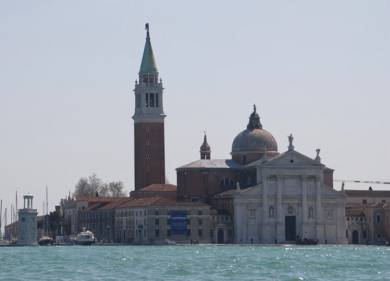
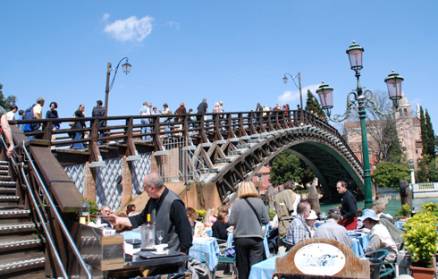
scale, touristy Venice is well known through photos to almost everyone. The
Doge’s Palace, the Campanile, St. Mark’s, the Accademia Bridge, the Grand Canal,
the Rialto Bridge, the Bridge of Sighs, the Horses of St. Mark’s – they are
all very well known, but non-the-less remarkable for their familiarity. We
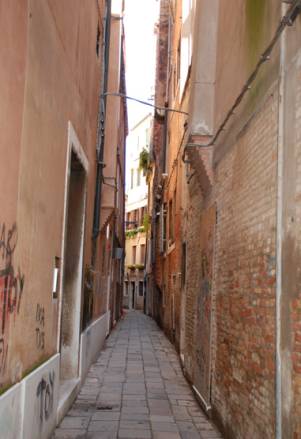
were lucky to be staying at the Fondazione Levi Music School, which had
provided accommodation for the participants in Inge’s symposium. Though this
palazzo, like so many, has a water entrance on the Grand Canal, its main
entrance is now from a typically Venetian narrow alleyway. |
|
|
|

|
|
|


|
|
|


|
Tom
last visited Venice at the age of twelve, but remembered little, apart from
the fact that it rained most of the time during the two or three days spent
there. The weather was better this time, which is one of the reasons we have
so may photos, as Vicky couldn’t resist almost continuous photo ops. The
Piazza San Marco is just as imposing as ever, especially if you get there
before the whole area is overwhelmed by day-trippers. We gathered that in
fact the vast majority of visitors to Venice only stay for a few hours and
see little more than the sights immediately around St. Mark’s. With Inge as
our tour director, there was no way that we would get away with that.
Exhaustive and exhausting coverage was the order of the day. But once we got
past the tourists’ grand sights, it was a fascinating place, particularly in
its more ordinary settings, if anywhere in a city like Venice can be called
ordinary. |
|
|
|


|
|
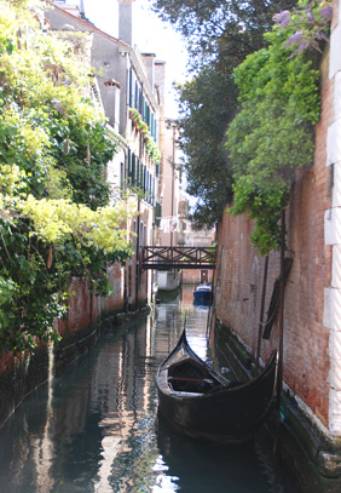
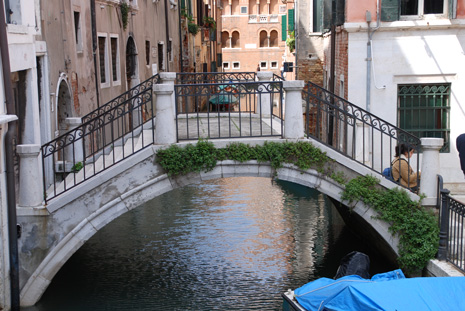
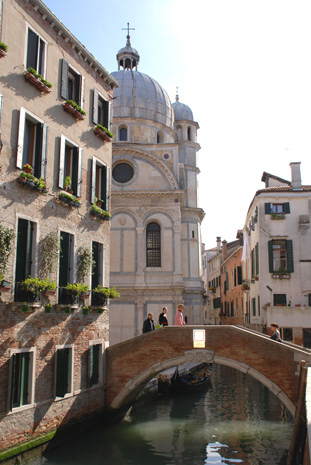
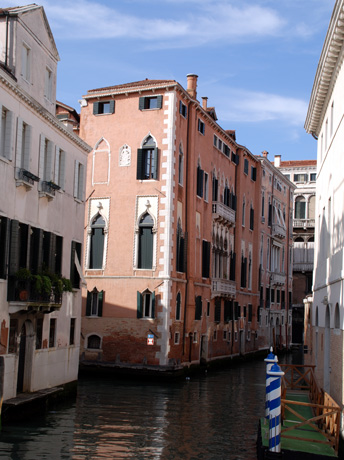
Even
some of the tourist sights like the Arsenale towers, give hints of this in the
building to the left, with it washing and peeling stucco. It was the small
side canals which give more of a feeling of what Venice might have been like
in the past than the grandeur of San Marco. For the most part these side
canals are quiet. Though all are ‘old’, the houses are in varied states of
repair, some with beautiful architectural touches, but most unremarkable.
However, almost all give hints in the functions of their windows and doors
and gates, of what Venice must have been like as a working, commercial city
in its heyday. |

|
|
|
|
|

|
|
|
|
|
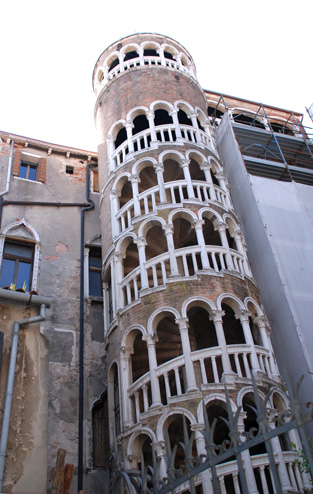
There
are also beautiful smaller architectural masterpieces tucked away, so that
you can find or miss them almost by accident – unless you have Inge guiding
you. And
of course everything of any weight is carried by water. The buses, ambulance,
fire appliances, police, store deliveries are all water-borne. Because Venice
is in a continual state of reconstruction and preservation, the builders also
work from the water, but with just as much noise and delay as builders
anywhere else. Naturally,
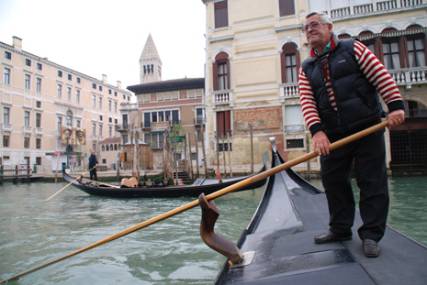
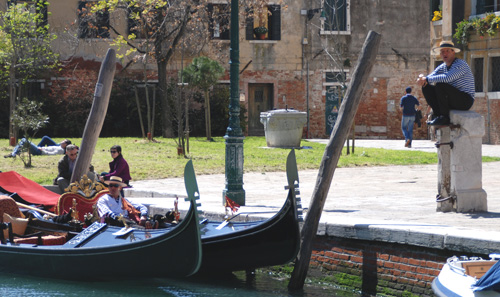
as sailors, we were also fascinated by the gondolas, from the highly polished
sleek models used entirely for the tourists, to the larger less burnished
traghetti, which act as minibuses for cross canal traffic. Their evolved
asymmetry and the functional beauty of the oarlocks are fascinating – whether
or not you are taken with the ‘romance’ of the gondolier. |
|

|
|
|

|
|
|

|
|
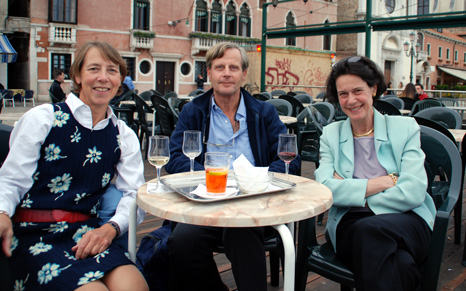
What
a good time we had – thanks to Inge. |
Next |